Power Plant Automation Integrator, Europe
Power generation
We automate electricity and heat production — steam and gas turbines, boilers, HRSG, hydro, district heating and renewable dispatch — from control system design through commissioning and acceptance testing. On our reference CHP plant that work covers three 120 t/h boilers, a 260 t/h CFB boiler at 100 bar, four turbines, and eleven years of continuous operation from 2007 to 2018, with maintenance again since 2022 — see project references and island mode operation on that site.
Equipment we automate
- Condensing steam turbine: Extraction and condensing turbines — governor, load control and acceptance testing.
- Back-pressure steam turbine: Back-pressure sets exporting steam to an industrial site.
- Gas Turbines: Simple-cycle and combined-cycle gas turbine control.
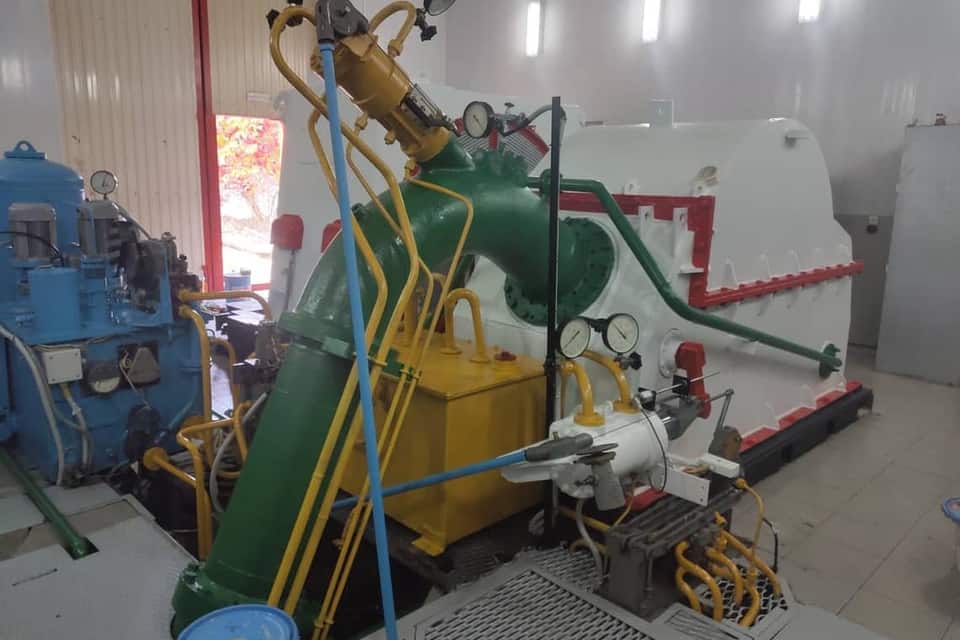
- Hydro turbines: Pelton units with nozzle and deflector control, governor and oil pressure unit management, protection design and unattended operation over telecontrol links — see Hydro Turbine Control.
- Heat Recovery Steam Generator: HRSG level, pressure and attemperator control in combined-cycle plants.
- Gas-fired steam boilers: Gas-fired boiler burner management and load control.
- Oil-fired steam boilers: Liquid-fuel boiler control and fuel metering.
- Multi-fuel steam boilers: CFB boilers firing gas, solid fuel and semi-liquid fuel — including automatic coke calorific value from the combustion result.
- Baghouse filters for ash handling: Ash handling on solid-fuel boilers.
- District heating: District heating network control and metering.
Renewable generation and dispatch
Wind farm SCADA and dispatch integration.
Remote and autonomous plant operation
Power plants under our control systems run unattended and are dispatched remotely over IEC 60870-5-104 telecontrol, carried on four redundant communication channels so that the loss of any single path does not interrupt control or data transfer. Scope covers the telecontrol gateway, signal mapping, redundancy switchover logic and testing of channel failover under load.
Turbine acceptance testing
Turbine control systems are commissioned and handed over against measured acceptance criteria, not against a checklist. Tests performed:
- Quality of primary frequency regulation
- Quality of secondary frequency regulation
- Rate of change of load
- Disconnection of the generator from the grid, with the unit held on house load
- Emergency stop and overspeed protection, including Braun turbine overspeed systems
Results are recorded and used for the certification of the turbine.
Island mode operation and load rejection
Where a plant has to keep supplying its site after separation from the grid, we implement the governor transfer, load shedding and frequency control that make it possible — proven on a running refinery CHP plant. See Island Mode Operation.
Grid code compliance and system operator interface
A generating plant is only connected as long as it answers to the system operator on the operator's terms. We implement that interface.
- Active and reactive power setpoint control from dispatch
- Reporting to the transmission system operator over IEC 60870-5-101
- Reporting to the market operator over IEC 60870-5-104
- Telecontrol over four redundant communication channels, so the loss of one path does not interrupt control or data transfer
- Primary and secondary frequency control, with the response measured at acceptance rather than assumed
- Resynchronisation after islanded operation
We have delivered this for conventional plant, for a photovoltaic park and for a wind farm dispatched as one balancing group — see virtual power plant.
Automatic boiler start-up
Starting a boiler by hand ties up an operator for hours and produces a different result every time, because the sequence depends on who is running it. We implement automatic start-up from a hot state as a sequence in the DCS: purge, burner light-off through the burner management system, ramp to minimum stable load against the drum thermal stress limits, and hand-over to load control.
The value is repeatability. The same ramp, the same stress on the drum, the same fuel consumed, whoever is on shift.
Plant-wide protection
Protection logic implemented across a whole station rather than machine by machine: four turbines, four boilers and the auxiliary equipment, so that a trip on one item takes the correct action on the rest instead of cascading.
Combined cycle power plants
Two gas turbines, a heat recovery steam generator and a steam turbine controlled as one unit, with SIL 3 safety systems. We have acted as the investor's representative on a CCPP automatic control system from design review through commissioning and operator training — see Combined Cycle Power Plants.
Power supply reliability for industrial sites
An industrial site connected to a weak grid loses production to events that are nobody's fault on site. The work of reducing that is part automation and part primary plant.
On a refinery CHP plant we have been part of a programme that took electrical supply incidents from twelve a year to two over six years, and incidents caused by operator action from four a year to none. Our part was the control system: islanding detection and transfer, automatic load setpoint computation for each possible island, emergency automation for the steam headers, and automatic start of the standby boiler.
The rest — differential protection with single-phase auto-reclosing on the 110 kV lines, breaker replacement, optical ground wire, fast automatic transfer switching on the 6 kV switchgear — is primary plant, and we have worked alongside it rather than on it.
See Island Mode Operation, Automatic Boiler Start-up and Hydro Turbine Control.